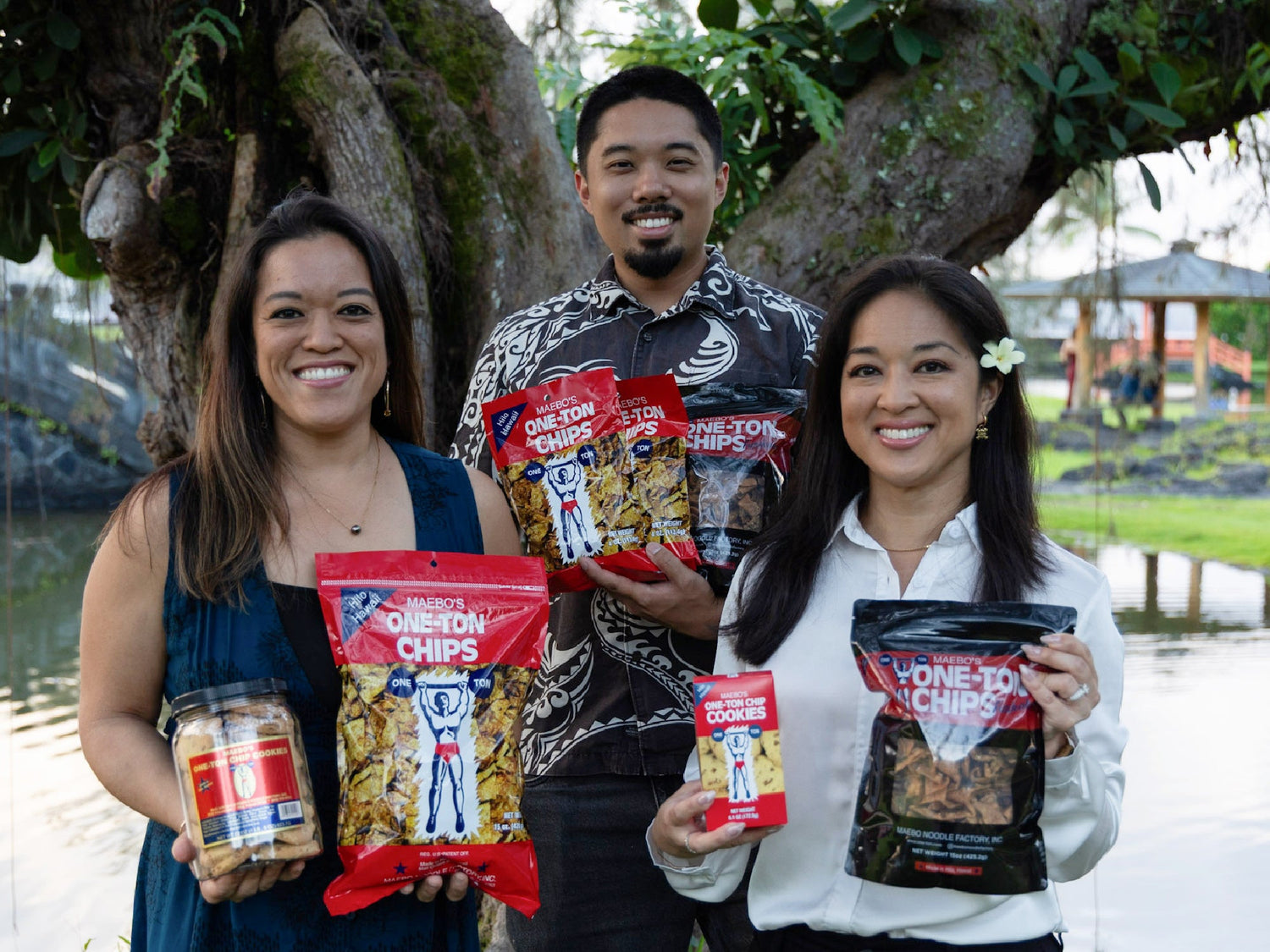
Three family members inherited a 75-year-old snack dynasty in Hilo. Now they’re remaking it for the next 75 — without a business school degree between them.
There’s an irony woven into the Maebo family story, and sisters Chasity Enoka and Porsche Haʻo, and cousin Jarek Maebo are the first to acknowledge it. None of them planned this. None of them trained for it. And yet here they are: fourth-generation owner-operators of one of the Big Island’s most beloved institutions learning everything on the fly, one batch of wonton chips at a time.
Maebo Noodle Factory has been part of Hilo’s fabric since 1950, when their great-grandparents started handmaking chips in a small carport and pedaling them around town on a bicycle to feed their eight kids. What began as a survival strategy became a legacy. What became a legacy is now, 75 years later, their kuleana — their responsibility — to carry forward.
Three Paths Back Home
If this were a tidy succession story, Chasity, Porsche and Jarek would have grown up knowing they’d take over. It wasn’t like that.
Chasity spent 11 years as a reservations agent at the Grand Wailea Resort on Maui before returning to run operations. Jarek never left — he’s worked at the factory his entire life, absorbing everything from production to compliance. And Porsche’s entry into the business wasn’t driven by ambition. It was driven by crisis.
Her husband had been laid off. Unemployment was nearly exhausted. Her mother had received a terminal prognosis. “The pressure was really on,” she says.
On a suggestion from her uncle, she turned to the factory’s scrap bin and started experimenting with the chip crumbs that would otherwise be thrown away. Within days, she had a new cookie recipe. Within months, she had a product in a KTA newspaper ad, which her grandmother clipped out and kept, beaming with pride.
“I remember sitting in my grandma’s room, where my mom was, and telling her that I was going to be okay if she passed,” Porsche says. (Her mother, against the doctor’s prognosis, survived.)
That cookie — the Maebo Chip Cookie, now a signature product — is a perfect encapsulation of how this business operates: nothing wasted, everything repurposed, hardship converted into something people love.
Building a business in Hawaiʻi means more than profit.

The Audit No One Thought They Could Pass
When a major distributor required Maebo to pass a Good Manufacturing Practices (GMP) audit, the factory wasn’t ready. Procedures were outdated. The requirements list was long. They hired a consultant — who at one point suggested that someone other than Jarek should handle it.
Jarek kept going. Over the course of a year, working through a dense body of regulatory knowledge with no formal background in compliance, he brought the factory up to standard. In 2022, they passed. They have passed every audit since.
“When we were informed that we had to undergo these in order to sell to major distributors, we didn’t know where to start,” he says. That he finished is the whole story.
Omiyage You Can Only Get on the Big Island
Chasity introduced the furikake chip to the Maebo lineup — a product now sold exclusively in their retail store and select KTA Supermarket locations. “It’s one of the few omiyage items that can only be bought on the Big Island,” she notes. That exclusivity is intentional. There’s something about scarcity that preserves meaning.
Her proudest moment wasn’t a product launch. It was a magazine feature — being recognized in Hawaii Business Magazine at a time when their grandmother was still alive. “We were able to share that recognition together across three generations,” Chasity says. Three generations, one photograph. The fourth, still writing its chapter.
The Real Challenge: Running a Business in Hawaiʻi
The trio are direct about what makes this hard. Shipping fragile cookies to the mainland is logistically painful. Supply chains are limited. Resources cost more on an island. Commercial real estate shifts constantly. Scaling a small-batch, hand-crafted operation in one of the most remote places in the world is structurally different from doing it anywhere else.
“Shipping the cookies to other places has been difficult because of their fragile nature,” Porsche says. “Shipping costs to other places are a lot, so customers need to pay more for the product. Resources of everything is limited, so costs are higher.”


Community as the Operating System
If there’s a word that runs through everything the Maebo family does, it’s ʻohana. The factory has always employed family — and not just blood relatives. Countless people over the decades have recalled how their grandparents and uncle treated everyone who came through the door as their own.
“Building a business in Hawaiʻi means more than profit,” Chasity says. “It’s about kūleana — showing up for our community, supporting local events, being there for one another. It’s about preserving values we were built on while creating opportunities for the next generation.”
“What really inspires me is seeing the impact our company has in the community, especially during the events we’re part of,” she adds. “Being there in person and connecting with people reminds me why what we do matters.”

The Next Five Years
Their vision is measured and practical: more automation at the current facility, possible expansion of production to a location where resources are more accessible, a gradual extension of their reach. They’re not chasing scale for its own sake. They’re chasing continuity.
“The thought that the past three generations have worked so hard for all that we have,” Porsche says, “and we have the responsibility and privilege to continue their legacy” — that’s what keeps her grounded. That’s what keeps all three of them going.
The One That Started It All
Ask Maebo's new leaders which product they’d reach for first and they quickly mention the chocolate chip cookie — the one born from factory crumbs and a moment of desperation that turned into something people can’t stop buying.
“The sweet of the chocolate and salty of the chips are a perfect combination,” they say. But "I think we’d have to go with the original one-ton chips at the top of the list because of its unique flavor and many different ways it can be used. We love seeing people enjoy it not just as a snack, but also in creative dishes and recipes."