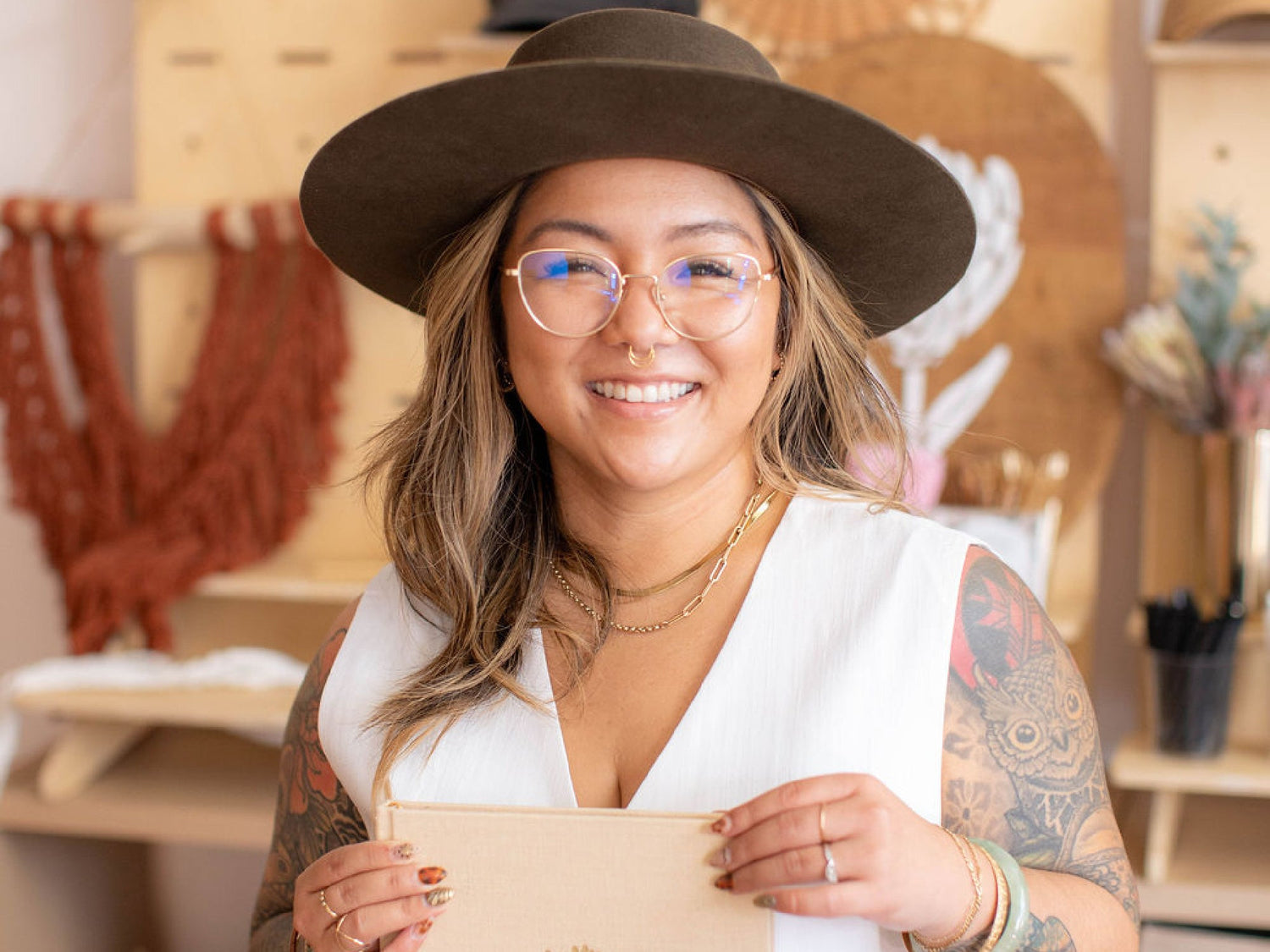
Jenna Ikeda started an Instagram account just to share her journals. Five years later, BUJOBAE has 10,000 orders, a Hilo headquarters, and a growing community of women who organize their lives — and find themselves — through her products.
There’s a particular kind of founder story that starts not with a pitch deck but with a feeling — a pull toward something that doesn’t yet have a name. Jenna Ikeda’s story is that kind. She was a medical assistant in Honolulu, studying toward medical school, with a biology and chemistry degree and a perfectly structured path ahead of her. On weekends, she journaled at coffee shops. Strangers kept stopping to ask about her planner.
“While working as a medical assistant, I turned to bullet journaling as a way to manage stress, organize my schedule, track my health, and stay creative,” she says. “People often approached me to say they admired my planner and wished they had the time, creativity, or ideas to create something similar.”
From Stethoscopes to Stationery
Before BUJOBAE existed as a brand, it existed as an Instagram page created simply to be part of the planner community. Ikeda had no intention of building a product line. Then she became a mother, and everything shifted.
“After becoming a mother, my perspective shifted and I felt called to create something meaningful and flexible,” she says. “I realized I could bridge that gap for others — I could design beautiful, intentional planners that combine organization with motivational elements that support mental wellness.”
“BAE” started as her alter creative ego. It has since become something larger: a community of people who use BUJOBAE products not just for planning, but to stay grounded. What looked like a planned business from the outside was, she’ll tell you, anything but — an organic evolution built from community, experimentation, and a lot of learning along the way.
Telling your story is your superpower.

The Cost of Creating Local
Starting a creative business in Hawaiʻi after COVID came with a challenge Ikeda hadn’t fully anticipated: being taken seriously. With a science background and no formal business training, she had to position herself as a legitimate business owner and artist, not just a hobbyist. As BUJOBAE grew, a deeper tension emerged — how to keep manufacturing local while staying affordable.
“That push and pull is ongoing, but it’s important to me that the majority of my products are still created and manufactured locally. It’s part of my values, and something I continue to prioritize as I grow.”


10,000 Orders — and the Stories Behind Them
The milestones are real: “Within two years of launching on Shopify, we reached our first 10,000 orders,” Ikeda says.
But the moments she holds closest aren’t the numbers. It’s a move from home operation to a dedicated Hilo headquarters, and expansion into markets in Japan that Ikeda calls “especially full circle” as a Hilo girl.
“I’ve had women share that BUJOBAE products have helped them step into promotions at work,” she says. “Through the workshops I teach, I’ve been able to create space for people to pause and prioritize their mental health. Those stories are what I’m most proud of — they’re a reminder that what we’re building goes far beyond paper products.”
Hilo in Every Page
Ikeda’s design language is rooted in autobiography. Living on Oʻahu when she launched, she wasn’t seeing stationery that reflected where she actually came from — so she put it there herself. In the anthuriums. In the colors. In the feeling of the Big Island woven into things people hold every day.
“Incorporating elements like anthurium was a way to represent my Hilo roots — to hold onto memories of my childhood and translate them into something people could use in their daily lives. It’s subtle, but intentional.”
A Register Date as a Memorial
Ask Ikeda what keeps her grounded and she gives you three things: journaling, Hilo, and her father. She registered BUJOBAE on June 1, 2021. Her father — an architect and business owner who shaped how she thinks about craft and integrity — passed away on June 1, 2014. The date was chosen deliberately.
“My father is a major grounding force in my journey,” she says. “The way he lived his life and ran his company left a lasting impression on me. In many ways, my business is a continuation of that legacy — but the BAE way.”
Journaling, she says, is her daily ritual — she is “truly a product of my own products.” And Hilo keeps her honest. “It’s home in the most honest, humble way. I’m proud to represent it and to tell stories through my work that reflect where I come from and what shaped me.”

The Book She Always Meant to Make
When Ikeda launched BUJOBAE, the very first product she envisioned was the Undated BUJO. She didn’t make it first — she waited until she’d grown enough as a designer and business owner to do it right. Now it’s her favorite product.
It’s undated, so it can meet people wherever they are. In that way, it’s less a planner than a philosophy: intentional living doesn’t run on a fixed schedule. It starts whenever you’re ready.
“It’s essentially a lookbook of past, present, and favorite designs and colorways — all rooted in the bullet journal system that inspired the brand from the beginning,” she says. “It feels like you’re journaling with me.”
On what she’d tell someone starting out in Hawaiʻi, Ikeda keeps it to three truths: “It’s never a failure — it’s a learning lesson. Telling your story is your superpower. The people in your corner matter and make all the difference.”