Waimea Herb Company didn’t begin as a business — it began as an afterschool program, a pot of māmaki, and a grandmother’s gout.
Mālie Sarsona was a teacher at Kanu O Ka ʻĀina, a Hawaiian Charter School, when she and her parents Heather and Owen launched Huli Ka Lima I Lalo — an afterschool program to reconnect keiki with their food and culture. For those kids, tea didn’t come from leaves. It came from bottles. From powder packets. From somewhere else entirely.
That moment of disbelief — a child holding a fresh sprig of lemongrass, suddenly understanding — is where Waimea Herb Company really begins. Not with a business plan, but with a plant.
“When they realized tea could be grown from leaves and flowers, they were mind-blown,” Sarsona says. “And when they learned that different plants could do different things — like help you sleep or give you energy — they couldn’t believe it.”
A Program, Not a Pitch
The goal was straightforward: reconnect children to their food. Teach them to grow gardens. Prepare meals from scratch. Restore a relationship that had quietly eroded over generations.
But the more time they spent with the kids, the more the founders saw a larger pattern. Processed snacks, sugary drinks, and families dealing with chronic conditions — gout, diabetes, high blood pressure — at alarming rates, especially within Native communities. The program became about more than education.
“These kids were destined to continue a pattern that was destructive but so easy to follow,” Sarsona says.
Tūtū’s Gout Changed Everything
The tipping point came quietly, through the kids themselves. Sarsona and her team began sending teas and food home with the children to share with their families. Then the reports started coming back.
“Tūtū said the māmaki lemongrass helped her gout yesterday. Can I bring more home?”
Small requests became larger ones. Families started asking for teas for gatherings, celebrations, gifts. Then people outside the program started reaching out entirely. The community had found something it didn’t know it was looking for — and Waimea Herb Company was born not from ambition, but from need.
We’re building in a competitive market, but we’re doing it with a slower, more thoughtful Hawaiian approach.


Growing with the Moon
What sets Waimea Herb Company apart isn’t just what’s in the bag — it’s how it got there. The company farms with moon cycles and teaches its partner farmers to do the same. It works exclusively with native and endemic mea kanu. It moves with its plants, not against them.
“We’re building in a competitive market, but we’re doing it with a slower, more thoughtful Hawaiian approach," Sarsona says. "That means we can’t force production or harvest on demand.”
That intentionality extends to language. Sarsona is clear-eyed about what it means — and doesn’t mean — to call something Hawaiian. “To us, it should be exactly that — grown here, made here, rooted here. Otherwise, it loses its meaning.” What comes from the ʻāina, she says, should always find its way back.
The Hardest Balance: Survival and Growth
Building a business in Hawaiʻi while holding down full-time jobs, raising families, and operating at capacity is a particular kind of weight that no pitch deck fully captures. For Sarsona and her co-founders, every decision — when to hire, when to lease a space, when to pay themselves — carries consequences that ripple far beyond the business.
“We grow up hearing that in order to really make it, you have to leave,” Sarsona says. “That success exists somewhere else.” Building something here — and having it work — means proving that wrong. Not just to the outside world, but to the people around them who are wondering if they can do the same.
“Growth here isn’t just about scaling quickly — it’s also about building something that can sustain both the business and the people behind it in the long run,” she says.
For the first seven or eight years, Waimea Herb Company made between $64 and $200 annually. Not because the demand wasn’t there — but because giving it away felt more natural than selling it.
“A lot of what we did was just because we didn’t know what we were doing,” Sarsona says. “We just knew what people needed and what had to be done.”
Every Saturday Is the Proudest Moment
Ask Sarsona about her proudest moment and she won’t point to a single milestone. She’ll point to the farmers market — every Saturday, without exception.
“People share feedback on our teas or tell us how they sent it to family members who are homesick and just want something ‘real’ from Hawaiʻi,” she says. “We have business owners telling us it sold out in a week and they want to double their next order. We get to be part of their everyday lives, their gatherings, and their stories.”
Sarsona describes a slow, visible shift in the community — less artificial at parties, more intention behind what people choose. More support for things actually grown and made here, by local hands. “It’s such a huge honor to be part of all of it.”
The Tea That Finds the Right People
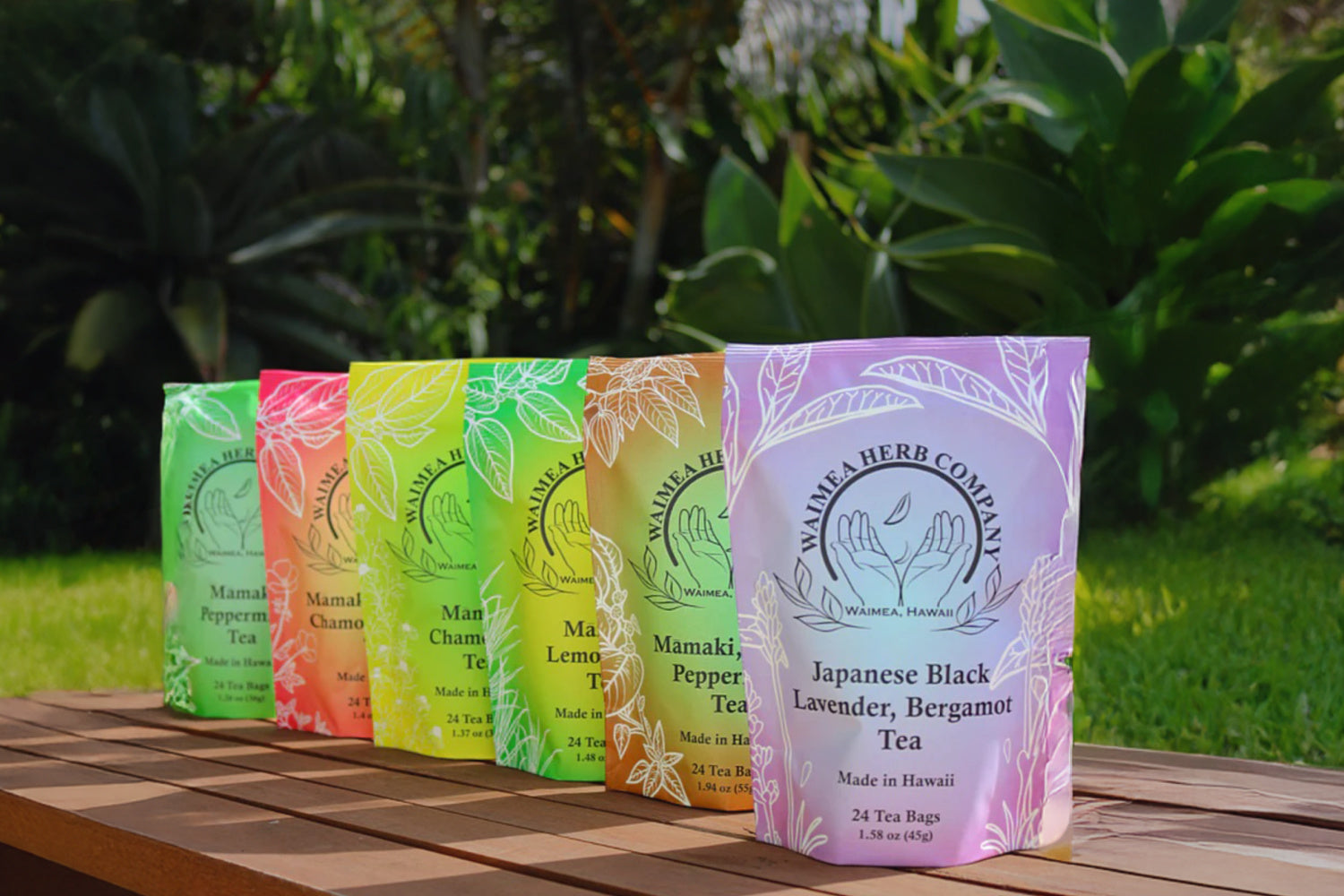
Sarsona’s favorite product is the Māmaki ʻAwa and Chamomile tea — and the way she describes it says everything about what Waimea Herb Company is actually building.
“This tea always seems to attract the most interesting people with the best stories,” she says. “Whether it’s a kūpuna dealing with arthritis or an uncle in construction who hasn’t been able to sleep well for years, this blend always seems to find the people who need it most.”
The blend uses only Hawaiian varieties of ʻawa — rare, intentional, and tied directly to the livelihoods of older farmers whose knowledge is as rooted in place as the plants themselves. Supporting the tea means supporting them. “Being able to support them means they get to continue doing what they love, in the way they’ve always known, and in the place they belong.”
When the pressure of running a business gets loud — the packaging decisions, the brochure wording, the logistics — Sarsona has a ritual. She goes back to the land. Literally.
“I just have to take a step back and quite literally go touch grass,” she says. “I’ll go to a neighbor’s house to help pull weeds in their greenhouse, go clear a loʻi, help pick ʻulu and drop it off at the Food Basket, or just go see who needs an extra hand on the farm. At the end of the day, I’m reminded of why we even exist and why we do what we do. All of a sudden, my problems are no longer an issue and I’m ready to keep moving forward with my best mindset.”
Her Advice
When you are doing something good for the right reasons, everything will fall into place when the time is right, says Sarsona about those contemplating starting their own businesses.
“Start before you’re ready,” she advises. “It’s never going to be perfect because the target is always changing. Be excited about every win. When it doesn’t work out, go home and cry, then go back out and fix it. You’re never alone. You just have to start.”